Spot Paintings for the Ninety-Nine Percent
Imcompletable Damien Hirst
by Terry Talty
Feb. 14, 2012
The Incompletable Spot Paintings from the Tin Shop Breckenridge, 2012.
Limitless Idea Project presents the Incompletable Spot Paintings, online at www.unsafeArt.com/Damien-Hirst-Style.
Interact with 11 galleries – a gallery for each arrangement of colored spots – and their inexhaustible random color combinations.
Like the Compete Spot Paintings by Damien Hirst, these virtual exhibitions allow viewers to contemplate the wide world of colored circles – but in a near-infinite way.
The Incompletable Spot Paintings in Breckenridge, Feb. 14, 2012.Colored circles may seem like a simple subject, but Hirst spent the past 25 years painting them. And hundreds of them are being shown in multiple exhibitions this year.
Unlike Damien Hirst’s work being shown at 11 Gagosian Galleries around the world, the virtual spot paintings are available to anyone with a modern Internet browser – one that supports HTML5. To see all these spot iterations, viewers don’t need a jet-set bank account. No need to get on a plane, just on the Internet. Read more..
Fred Sandback and Critical Looking
MCA Precision
by Terry Talty
Oct 19, 2011

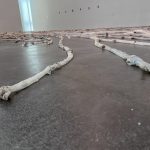
The work of Fred Sandback is installed at MCA Denver until Oct 23, 2011. This piece spans three floors.
Fred Sandback's work is at the Museum of Contemporary Art until the 23rd of October. Until then the museum is filled with lines drawn in yarn -- big lines, very precisely drawn in acrylic yarn.
A line pulls you into the main floor gallery and points to a square drawn in yarn that is attached in two points to the wall and two points to the floor. Some lines are different colors, but all are the same in that they are made of yarn. If it is two, three or four strands of yarn you hardly notice until you've seen several rooms of these shapes drawn in yarn. By that time you're noticing everything.
You notice as you walk down the hallway that the EXIT sign is not exactly hanging level. Some of the electrical plates are well ... to read more, see Fred Sandback.
Another Victory over the Sun
by Terry TaltyAugust 10, 2011
Another Victory over the Sun Means What?
Learning to step into the shade was my first victory over the sun. Is this show about how man's ingenuity can beat nature's unpleasantness? Or do we need to know the art history themes attributed to the first Victory Over the Sun to get this show?
Victory Over the Sun is the title of a 1913 opera produced by Russians called Youth Group. They included adults as old as 50 so this was no camp project but an assertion of their own importance from a new group of 'emerging' artists - poets who wrote the libretto in Zaum, a language developed from the emotional and instinctual quality of sounds - and artists, including Kazimir Malevich, who is often credited with making the first abstract painting. A reproduction of this Victory, made by the California Institute of the Arts, plays in the elevator, if you wish to watch it. The opera, Internet research points out to me, claimed to vanquish the 'sun,' a symbol for the previous generation of artists, called the Symbolists, rational, intellectual, nature lovers. The new school victors' were right to gloat because their thinking did predominate art for the next twenty years, evolving into, generally, surrealism. These artists made paintings and poetry with whatever came out of their heads. Natural man triumphs over the sun and rationality.
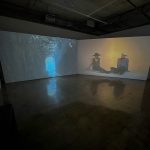
The show directs us to this opera as a source, and then does some of its own battling with the sun. For Another Victory Over the Sun museum staffers blocked out all natural light. This building is no windowless schoolhouse, but a green building that uses natural light for most of its daytime illumination and the effect is noticeable. The entry is lit by a Dan Flavin piece called Monument to V. Tatlin. Tatlin was another Russian artist from the early 20th century. Anyone standing near the piece glows fluorescent.
The other works in the show produce their own light, too, and it helps to illustrate the exhibition notes that claim art can create a reality more intense than its architecture. Art is like a campfire, we're told, it is more than its logs and twigs.
Man over Nature, New over Old, Emotion/Instinct/Feeling over Rational Intellect, Art over Tangibles: that's our list of given possible themes. To read more, read No Sun in Museum.
Hermann Nitsch Talks at MCA Denver
Austrian Artist talks about making Orgy Mystery Theatre
by Terry Talty
February 25, 2011

Hermann Nitsch speaks at MCA Feb. 25, 2011.
DENVER, COLORADO - Hermann Nitsch is more than 70 years old, and the audience listened to him talk Thursday night at the Museum of Contemporary Art Denver treating him with reverence.
The audience jibed familiarly with MCA director Adam Lerner as he introduced Nitsch, whose half dozen paintings and dozen religious vestments are on exhibit in the museum. Warmly, but casually, they greeted the team of interviewers: Patrick Greanley, a European literature scholar, and curator Simon Zalkind. The audience hushed to hear the artist speak.
The Austrian started in English and when he got rolling switched to German, and Greanley peddled hard to deliver the translation quickly and unobtrusively.
Zalkind asked questions I wanted to ask and with an intelligence I wished I had. My repetition of these questions is such a weak approximation: How did Nitsch get the idea to use performance so early, in the'60s? How was Nitsch influenced by Abstract Expressionism (a largely American movement important in the 1950s)?
It wasn't so much what Nitsch said — he listed influences like Mallarme, Pollack, deKooning, many names that most audience members could pick out from the man's German with a good amount of effort — it was the way he barely moved as he delivered the answers. And was rewarded with an odd reverence and hush. When he said Freud and Jung and John Cage, we felt we could lighten up. He'd sounded so ethereal, eclectic, and then it was obvious, performance comes from John Cage. This guy was part of the consciousness of his time. Then he names his special influence — spirit. Not the kind bound to any religion, but the spirit that drives action. Then Zalkind pressed him on the weird nature of his form of self expression and Nitsch talked more about the all-encompassing power in humans and how it is bound too tightly by civilization. He's about unleashing all that human power.
To read more about the show, Bloodlines...
Dale Chisman Retrospective - Robischon and Redline
How Jesus would want to show his paintings
by Terry Talty
January 27, 2011

Dale Chisman Retrospective at Redline Gallery until Feb. 20, 2011.
DENVER, COLORADO - Dale Chisman was a Colorado artist. He graduated from the University of Colorado in Boulder and knew a lot of people who care about art in Denver, Boulder and the rest of the state. He died recently and there have been a few opportunities to see his work. But the current retrospective at RedLine is how I'd want to see my work if I was a painter like Dale Chisman.
The show is curated by Jennifer Doran Robischon, and more of the retrospective is at Robischon Gallery. To read more about the Retrospective up until Feb. 20, see Dale Chisman....
Damn nice drawings at the DAM
Marc Brandenburg: Dec 2010 to Feb. 20, 2011
by Terry Talty
Jan, 18, 2011
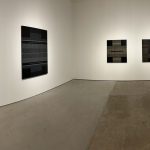
Drawing show at the Denver Art Museum through Feb. 20, 2011.
Denver - Drawings of a photographic negative done with a great amount of skill and sensitivity to the beauty of graphite laid down on paper. This describes the drawings done by Berlin artist Marc Brandenburg, which are currently on show on the 3rd floor of the Hamilton building of the Denver Art Museum. and will remain on view until Febrary 20, 2011.
We can recognize the imagery although it is a negative - everything that would be white is black and vise-versa - of people or landscapes.
Mostly people. Realistically drawn people I found interesting to look at because of the skill of the drawing, but I didn't feel like a voyeur because they were the negative. Oddly, I felt like I had permission to stare, and not feel I was staring at a human.
To read more about Marc Brandenburg ...